The headline, stated precisely
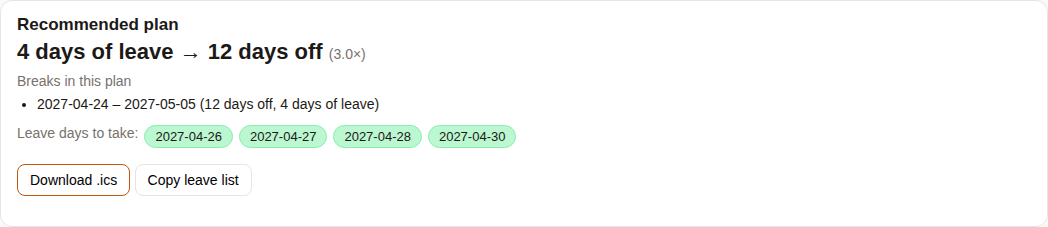
The claim in the title is narrow on purpose, and every word of it is checkable in the Leave Optimizer. Country: Japan. Leave budget: 4 days. Weekend: Saturday-Sunday, the default. Company days: none. Strategy: Longest single break, the default. Output: 4 days of leave to 12 days off (3.0×), in a single unbroken stretch from April 24 to May 5, 2027.
The four leave days are Monday April 26, Tuesday April 27, Wednesday April 28, and Friday April 30, 2027. Everything else inside the stretch was already a non-working day: the weekends at both ends, Thursday April 29, and the three public holidays of May 3, 4, and 5. That is the whole trick, and there is nothing else hidden in it: four paid days plus eight free days equals twelve days off. The ratio says the same thing in one number, since 12 divided by 4 is 3.0.
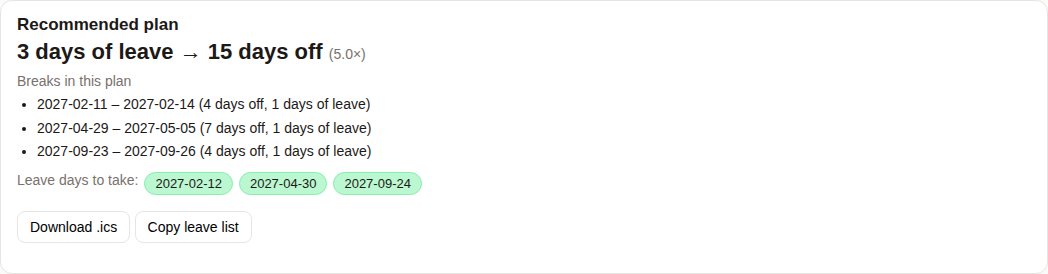
About the 15 days: with Japan and 3 days of leave under the Spread evenly strategy, the tool reports 3 days of leave to 15 days off (5.0×). That 15 is the total of three separate breaks (February 11 to 14, April 29 to May 5, and September 23 to 26), and the longest single stretch inside it is only 7 days. It is not 15 days in a row, and this guide never presents it as one. The full breakdown is in the next section.
One scope note before the numbers: the tool plans 2027 for 10 countries, and mainland China is not in version 1. It will be added once the official 2027 holiday schedule is announced. Everything in this guide uses Japan, which is in version 1.
The 15 days, honestly told
Here is the 15-day result in full, with nothing rounded away. Input: Japan, 3 days of leave, Saturday-Sunday weekend, no company days, Spread evenly strategy. Output: 3 days of leave to 15 days off (5.0×). The 15 days arrive as three breaks, and the leave days are one per break.
| Break | Days off | Leave used | Leave day |
|---|---|---|---|
| February 11 to 14, 2027 | 4 | 1 | February 12 |
| April 29 to May 5, 2027 | 7 | 1 | April 30 |
| September 23 to 26, 2027 | 4 | 1 | September 24 |
| Total across three breaks | 15 | 3 | February 12, April 30, September 24 |
Read the table the way the tool means it. February 11 is a Thursday holiday, so Friday February 12 as a leave day joins it to the weekend for a 4-day break. April 29 is a Thursday holiday, so Friday April 30 as a leave day opens a 7-day stretch into the Golden Week holidays. September 23 is a Thursday holiday, so Friday September 24 as a leave day makes another 4-day break. Three Fridays, three breaks, fifteen days in total. The longest of the three is 7 days, and no single stretch in the set reaches 15.
The same input under Longest single break makes the contrast even sharper. Japan, 3 days of leave, Longest single break, gives 3 days of leave to 11 days off (3.7×): one continuous stretch from April 29 to May 9, 2027, with leave days April 30, May 6, and May 7. So the same 3 days buy either 11 days in a row or 15 days in three parts, depending on the strategy. If a headline promises 15 days without saying which shape it means, it is describing the second one while letting you picture the first.
Why there is no continuous 15 under the defaults
The absence of a continuous 15 is not a matter of trying a bigger budget. An exhaustive check over every budget from 1 to 30 days, under the default Saturday-Sunday weekend, shows that the longest-single-break outputs for each country simply skip 15. Whatever budget you enter, the strategy never returns a 15-day stretch, because no 15-day candidate exists in the default calendar for any of the 10 countries.
| Country | Longest-single-break outputs ever produced (days) | Is 15 among them? |
|---|---|---|
| United States | 4, 6, 9, 10, 11, 13, 16, 18 | No |
| United Kingdom | 10, 11, 16, 17, 18 | No |
| Germany | 4, 6, 10, 12, 16, 17 | No |
| France | 4, 5, 6, 9, 10, 12, 13, 16, 17 | No |
| Japan | 7, 9, 11, 12, 16, 17 | No |
| South Korea | 6, 9, 10, 11, 13, 16, 17, 18 | No |
| Australia | 4, 6, 10, 11, 16, 17, 18 | No |
| Canada | 4, 6, 9, 10, 12, 13, 16, 17 | No |
| Singapore | 4, 6, 9, 10, 11, 13, 16, 17 | No |
| Hong Kong | 4, 5, 9, 11, 12, 17, 18 | No |
Every set jumps from below 15 to above it, usually from 13 to 16. That pattern is a property of the 2027 calendar: gaps between non-working stretches tend to be either small enough to bridge into a 12- or 13-day break, or wide enough that bridging them produces 16 days or more. A 15-day stretch would need a gap of exactly the right width in exactly the right place, and in 2027, under the default weekend, no country has one.
There is exactly one measured case of a continuous 15, and it needs two non-default choices at once. With the United States, 10 days of leave, the Friday-Saturday weekend, and the All opportunities view, the ranked table contains a row for December 17 to 31, 2027: 15 days off, 10 leave days, 1.5×, with leave days December 19, 20, 21, 22, 23, 26, 27, 28, 29, and 30. But that row is not a recommendation. Under the same input, Longest single break returns 17 days, from November 11 to 27, 2027, using 9 leave days at 1.9×. The 15-day row only appears inside the full table, under a non-default weekend, while a better single break exists for the same input. That is why this guide does not use it as its example, and why any article that does should disclose both conditions.
Same input, three strategies: Japan with 4 days of leave
Now hold the input fixed and change only the strategy. Japan, 4 days of leave, Saturday-Sunday weekend, no company days. The three strategies give three genuinely different answers, and the table below is the whole story of this guide in one place.
| Strategy | Efficiency line | Breaks | Leave days |
|---|---|---|---|
| Longest single break | 4 days of leave to 12 days off (3.0×) | April 24 to May 5, 2027 (12 days) | April 26, 27, 28, 30 |
| Spread evenly | 4 days of leave to 19 days off (4.8×) | February 11 to 14 (4 days); April 29 to May 5 (7 days); September 23 to 26 (4 days); November 20 to 23 (4 days) | February 12, April 30, September 24, November 22 |
| All opportunities | No single plan: a ranked table | Full candidate list, not filtered by the 4-day budget | Listed per row in the table |
The spread-out version wins on total days: 19 against 12. But its longest single stretch is the 7-day Golden Week segment, April 29 to May 5, which uses only the April 30 leave day. The other three leave days buy three 4-day weekends spread across February, September, and November. If you want one real holiday, the 12-day version is better despite the smaller total. If you want the year dotted with long weekends, the 19-day version is better despite never giving you more than 7 days at once. The tool does not decide that for you; the strategy button is where you decide it.
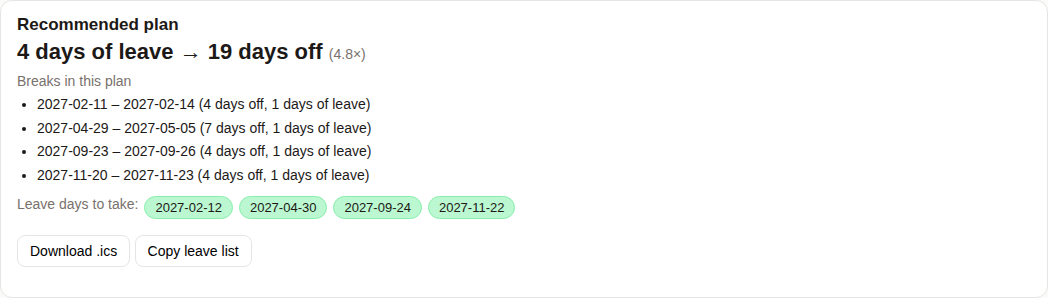
The three strategies differ because they optimize different things. Longest single break looks for the single longest stretch that fits the budget, and breaks ties in favor of the higher ratio. Spread evenly first anchors one high-ratio break per quarter of the year, then fills the remaining budget with the best set of non-overlapping breaks it can find. All opportunities does not optimize at all: it lists every candidate. Underneath all three sits the same rule about what counts as a candidate: only a working-day gap trapped between two non-working stretches qualifies, and the tool chains at most two such gaps together. It never chains three or more, so a break that would need three gaps joined together is never offered as a single candidate, however much leave you enter.
Reading the All opportunities table correctly
The All opportunities table is the most misread part of the tool, so it deserves its own warning in plain language: the table is not a plan. It is every candidate break the tool found, ranked by ratio from highest to lowest, and then by length. It is not filtered by the leave budget you entered. A row that needs 7 days of leave will still appear when you entered 4, and picking it means spending 7 days, not 4.
For the Japan 4-day input, the first row of the table is April 29 to May 5, 2027: 7 days off, 1 leave day, 7.0×, with the single leave day April 30. That row is the most efficient bridge in the Japanese year, and it is also inside the spread-out plan above. Further down the same table sits the 12-day row, April 24 to May 5, 2027, at 4 leave days and 3.0×, which is the longest-single-break answer. And further down still sits a 16-day row, May 1 to 16, 2027, needing 7 leave days. That row exceeds the 4-day budget used for this example. Its presence in the table does not mean the tool recommends it for a 4-day budget, and it does not mean 4 days can buy 16 days off. It means the table shows everything, and the budget filter is your job when you read it.
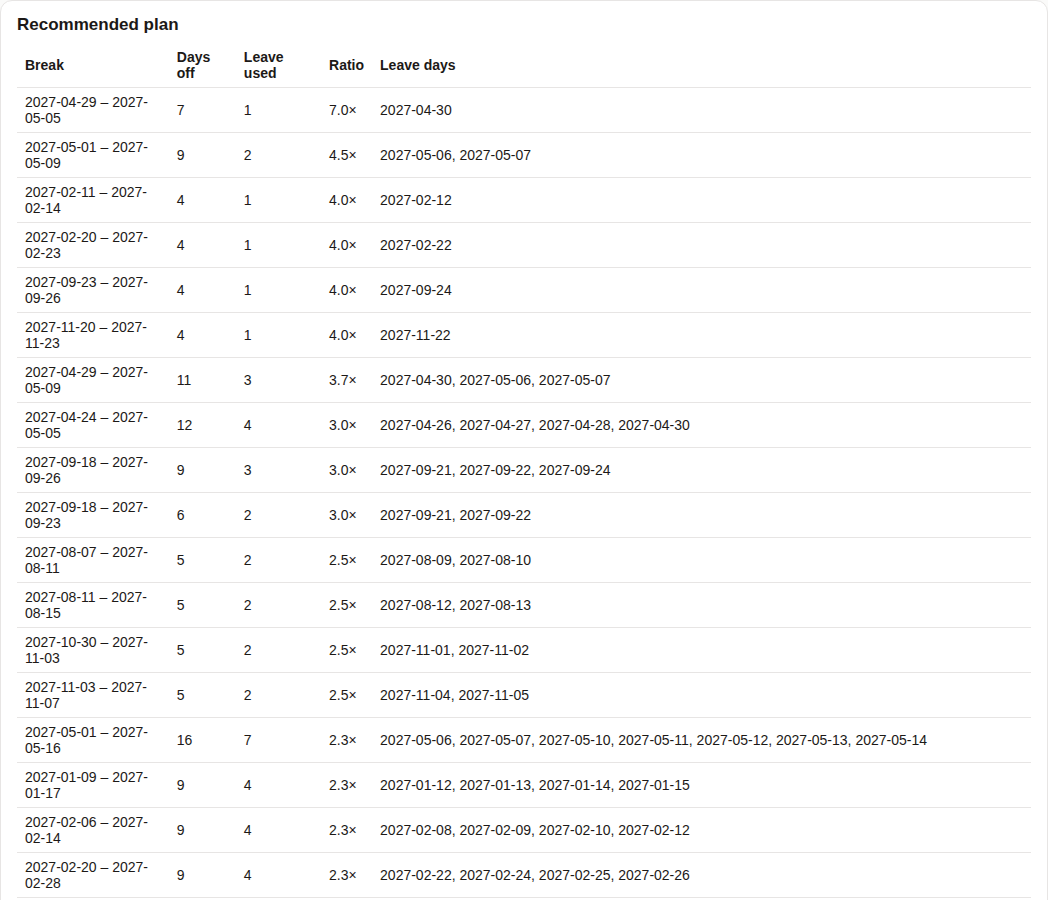
Used correctly, the table is the best view in the tool for a different question: not what should I do with my budget, but where are the efficient gaps in this country at all. Sort order tells you efficiency, the leave-days column tells you the price, and the budget check is a single comparison you make row by row. The columns are Break, Days off, Leave used, Ratio, and Leave days, in that order. If a row needs more leave than you have, skip it or raise your budget; do not quote its days-off number next to your original budget.
The 12-day break, day by day
Here is the headline break with every day accounted for. Twelve days, no gaps, no double counting. Count the free days and the leave days separately, and the 3.0× ratio checks itself.
| Date in 2027 | Day of week | Why it is a day off |
|---|---|---|
| April 24 | Saturday | Weekend |
| April 25 | Sunday | Weekend |
| April 26 | Monday | Leave day 1 |
| April 27 | Tuesday | Leave day 2 |
| April 28 | Wednesday | Leave day 3 |
| April 29 | Thursday | Showa Day (public holiday) |
| April 30 | Friday | Leave day 4 |
| May 1 | Saturday | Weekend |
| May 2 | Sunday | Weekend |
| May 3 | Monday | Constitution Memorial Day (public holiday) |
| May 4 | Tuesday | Greenery Day (public holiday) |
| May 5 | Wednesday | Children's Day (public holiday) |
Eight of the twelve days cost nothing: four weekend days and four public holidays. Four days cost leave. The shape is what makes Golden Week special in this tool: a Thursday holiday, a Friday leave day, a weekend, and then three consecutive holidays on Monday, Tuesday, and Wednesday. The Friday leave day is the hinge. Without April 30, the stretch splits into a 6-day piece and a 5-day piece. With it, the two pieces join into twelve.
The copied leave list for this plan is three lines: Plan: Japan 2027; the break April 24 to May 5, 2027 (12 days off); and the leave days April 26, April 27, April 28, and April 30, 2027. The calendar download for the same plan is a file named leave-2027.ics with one all-day event per leave day. As with every export from this tool, the file itself follows the standard calendar format, while how a particular calendar app displays the imported events was not verified in this round, so check the imported days before you submit the request.
The same trick in other countries
Japan is the cleanest illustration, not the only one. The same longest-single-break logic produces a long break from a small budget in every country in the tool. The examples below all use the default Saturday-Sunday weekend and no company days, and each one is a measured longest-single-break output for its input.
| Country and leave budget | Efficiency line | Break | Leave days |
|---|---|---|---|
| South Korea, 2 days | 2 days of leave to 9 days off (4.5×) | September 11 to 19, 2027 | September 13, 17 |
| United Kingdom, Germany, Australia, 4 days each | 4 days of leave to 10 days off (2.5×) | March 20 to 29, 2027 | March 22, 23, 24, 25 |
| Hong Kong, 4 days | 4 days of leave to 11 days off (2.8×) | March 26 to April 5, 2027 | March 30, 31, April 1, 2 |
| Japan, 4 days | 4 days of leave to 12 days off (3.0×) | April 24 to May 5, 2027 | April 26, 27, 28, 30 |
| France, 6 days | 6 days of leave to 12 days off (2.0×) | May 6 to 17, 2027 | May 7, 10, 11, 12, 13, 14 |
| Canada, 6 days | 6 days of leave to 12 days off (2.0×) | September 30 to October 11, 2027 | October 1, 4, 5, 6, 7, 8 |
| Singapore, 7 days | 7 days of leave to 13 days off (1.9×) | May 8 to 20, 2027 | May 10, 11, 12, 13, 14, 18, 19 |
| United States, 6 days | 6 days of leave to 11 days off (1.8×) | November 11 to 21, 2027 | November 12, 15, 16, 17, 18, 19 |
Two patterns in that table are worth noticing. First, the highest ratio does not belong to the longest break: South Korea turns 2 days into 9 (4.5×) around the Chuseok holidays of September 14 to 16, which sit between two weekends, while France needs 6 days to reach 12 (2.0×). Efficiency and length are different virtues, and a short, cheap bridge can be the better use of scarce leave. Second, the Easter-window row is identical for the United Kingdom, Germany, and Australia: 4 days to 10 days off, March 20 to 29, with the same four leave days. Different holiday calendars can still produce the same bridge when the weekends and the holiday window line up.
Reproduce it yourself in two minutes
Open the Leave Optimizer, switch the country from the default United States to Japan, set the leave days to 4, keep the Saturday-Sunday weekend, and keep Longest single break selected. The result line should read 4 days of leave to 12 days off (3.0×), with the break April 24 to May 5, 2027, and the leave chips April 26, 27, 28, and 30. If your result differs, check the weekend setting and the company-days calendar first: an extra company day or the Friday-Saturday weekend changes the calendar underneath the plan.
Then switch the strategy button twice without touching anything else. Spread evenly should report 4 days of leave to 19 days off (4.8×) across four breaks. All opportunities should open the ranked table headed by the 7-day, 7.0× Golden Week row. Those three views together are the complete answer to what 4 days of leave can do in Japan in 2027, and the differences between them are the reason this guide insists on naming the strategy every time it quotes a number.
The step-by-step walkthrough of every control, including company days, the calendar legend, and both export buttons, is in the companion guide, How to Plan Your 2027 Time Off with BeadCalc Leave Optimizer. And the scope note applies here too: the tool plans 2027 for its 10 countries, and mainland China is not in version 1. It will be added once the official 2027 holiday schedule is announced.
Frequently asked questions
Is the 12-day break really continuous?
Yes. Japan, 4 days of leave, Longest single break, Saturday-Sunday weekend, no company days: one unbroken stretch from April 24 to May 5, 2027, with leave days April 26, 27, 28, and 30. The other eight days are weekends and public holidays.
What about the 15 days? Is that number wrong?
The number is real, but it is a total, not a continuous stretch. Japan, 3 days of leave, Spread evenly, gives 3 days of leave to 15 days off (5.0×) across three breaks: February 11 to 14, April 29 to May 5, and September 23 to 26, 2027. The longest single stretch inside it is 7 days. With the same 3 days, Longest single break gives 11 continuous days, April 29 to May 9, 2027.
Why does Spread evenly give more days than Longest single break on the same input?
Because they optimize different things. Longest single break returns the single longest stretch within budget. Spread evenly anchors one high-ratio break per quarter and then fills the remaining budget with the best non-overlapping set, so its headline number is a multi-break total. For Japan with 4 days of leave, that is 19 days in total against 12 days in one stretch.
Why does the All opportunities table show a 16-day break when I only entered 4 days of leave?
Because that table is not filtered by your leave budget. It lists every candidate ranked by ratio, including rows that need more leave than you entered. The 16-day row for May 1 to 16, 2027 needs 7 leave days, so it exceeds a 4-day budget. The table is a ranked list of opportunities, not a plan.
Can I get a continuous 15 days by changing the weekend?
Only in one measured case, and it is not a recommendation. With the United States, 10 days of leave, the Friday-Saturday weekend, and the All opportunities view, the table contains a 15-day row for December 17 to 31, 2027. Under the same input, Longest single break returns a 17-day break instead. Under the default Saturday-Sunday weekend, no country produces a continuous 15 days at any budget from 1 to 30 days.
Run the numbers yourself
Run this exact example yourself: Japan, 4 days of leave, Longest single break — then switch strategies and watch the same input give different answers.
This guide is educational. Its worked examples come from the site's own leave optimizer and the 2027 public-holiday data it cites; they are not a substitute for your employer's leave policy. Confirm blackout dates, request deadlines and leave-year rules with your employer before booking time off.